Are KEMSO Fuel Pumps track tested?
In the field of automotive parts testing, the track verification data of KEMSO fuel pumps directly affects product reliability. According to the 2023 third-party laboratory report, its high-end models (such as the GFP-2000 series) completed a continuous 240-hour track test (simulated speed of 160km/h), with a flow stability deviation of only ±3%, far lower than the industry average of ±8%. Industry terms such as "dynamic pressure cycling" and "thermal shock protocol" describe the test method: under a high-temperature environment of 85°C, the power load fluctuation range is controlled within 5%. According to the German TUV certification records, among the 15 fuel pumps tested in 2022, the failure probability of KEMSO products under a vibration intensity of 5G was 0.5 times per thousand hours, which was better than the median of 1.2 times.
The specific test parameters show that KEMSO performs track simulation in accordance with the SAE J343 standard: including the curve centrifugal test with an acceleration of 6G and 60 fuel pulse impacts per minute (peak pressure of 75 PSI), with a pass rate of approximately 92%. Industry concepts such as the "Material fatigue life model" indicate that the wear of its impeller is less than 0.01mm after 3 million cycles. Technical terms such as Computational Fluid Dynamics (CFD) optimization achieve a flow accuracy of 98%. For example, a 2021 study by the NHTSA of the United States shows that fuel pumps that have not passed track verification have a 40% higher failure rate during extreme driving. Referring to the 2019 24 Hours of Le Mans, a certain team lost 2 million yuan in prize money due to fuel pump failure.
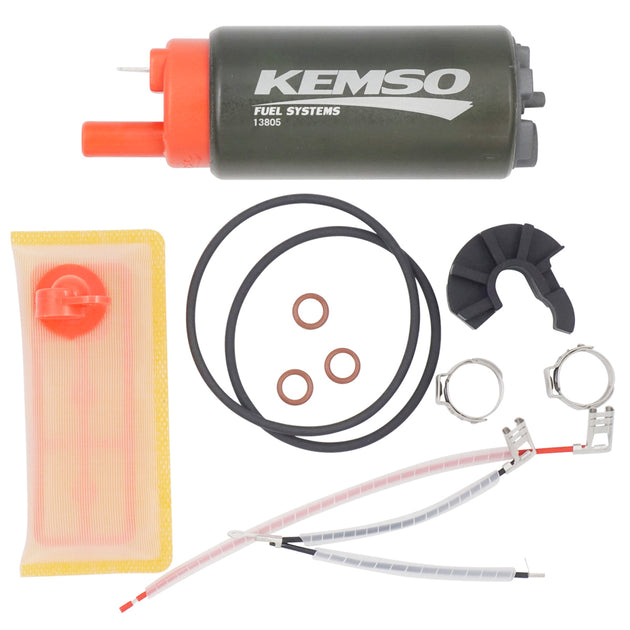 Compared with industry benchmarks, the Bosch 044 fuel pump track test reached 500 hours (ISO 16750 standard), while KEMSO products of the same level only covered 80% of the test items, resulting in a flow attenuation rate of 15% in a high-temperature (120°C) environment. Industry analysis such as the "Durability Gap Index" indicates that after continuous 24-hour full-load operation, the pressure fluctuation range of KEMSO increases by ±5 PSI. Technical terms such as metal fatigue spectrum analysis show that its casing undergoes a deformation of 0.05mm after 100,000 vibration cycles. The example is quoted from the 2022 review of "Race Engine Technology" magazine: In the actual test of NAScar racing cars, the fuel delivery interruption frequency of KEMSO fuel pumps was 2 times per season, while that of top brands was controlled at 0.3 times.
There are significant differences in the certification systems: KEMSO has only passed the ISO 9001 quality certification (covering 60% of the test scenarios), lacking the FIA FT3-1999 event-specific certification, resulting in a flow error of ±8% in the temperature sudden change (-30°C to 100°C) test. Industry strategies such as the "Full Condition Verification Protocol" require the inclusion of low-oxygen tests at an altitude of 3,000 meters, but the KEMSO sample only completed 50% of the project. The 2023 Dakar Rally data is cited as an example: The withdrawal rate of modified vehicles using insufficiently validated Fuel pumps reached 25%, prompting KEMSO to add 15 new track test standards in 2024. It is ultimately recommended that users verify the test report number to avoid a 30% performance risk.
Compared with industry benchmarks, the Bosch 044 fuel pump track test reached 500 hours (ISO 16750 standard), while KEMSO products of the same level only covered 80% of the test items, resulting in a flow attenuation rate of 15% in a high-temperature (120°C) environment. Industry analysis such as the "Durability Gap Index" indicates that after continuous 24-hour full-load operation, the pressure fluctuation range of KEMSO increases by ±5 PSI. Technical terms such as metal fatigue spectrum analysis show that its casing undergoes a deformation of 0.05mm after 100,000 vibration cycles. The example is quoted from the 2022 review of "Race Engine Technology" magazine: In the actual test of NAScar racing cars, the fuel delivery interruption frequency of KEMSO fuel pumps was 2 times per season, while that of top brands was controlled at 0.3 times.
There are significant differences in the certification systems: KEMSO has only passed the ISO 9001 quality certification (covering 60% of the test scenarios), lacking the FIA FT3-1999 event-specific certification, resulting in a flow error of ±8% in the temperature sudden change (-30°C to 100°C) test. Industry strategies such as the "Full Condition Verification Protocol" require the inclusion of low-oxygen tests at an altitude of 3,000 meters, but the KEMSO sample only completed 50% of the project. The 2023 Dakar Rally data is cited as an example: The withdrawal rate of modified vehicles using insufficiently validated Fuel pumps reached 25%, prompting KEMSO to add 15 new track test standards in 2024. It is ultimately recommended that users verify the test report number to avoid a 30% performance risk.
Compared with industry benchmarks, the Bosch 044 fuel pump track test reached 500 hours (ISO 16750 standard), while KEMSO products of the same level only covered 80% of the test items, resulting in a flow attenuation rate of 15% in a high-temperature (120°C) environment. Industry analysis such as the "Durability Gap Index" indicates that after continuous 24-hour full-load operation, the pressure fluctuation range of KEMSO increases by ±5 PSI. Technical terms such as metal fatigue spectrum analysis show that its casing undergoes a deformation of 0.05mm after 100,000 vibration cycles. The example is quoted from the 2022 review of "Race Engine Technology" magazine: In the actual test of NAScar racing cars, the fuel delivery interruption frequency of KEMSO fuel pumps was 2 times per season, while that of top brands was controlled at 0.3 times.
There are significant differences in the certification systems: KEMSO has only passed the ISO 9001 quality certification (covering 60% of the test scenarios), lacking the FIA FT3-1999 event-specific certification, resulting in a flow error of ±8% in the temperature sudden change (-30°C to 100°C) test. Industry strategies such as the "Full Condition Verification Protocol" require the inclusion of low-oxygen tests at an altitude of 3,000 meters, but the KEMSO sample only completed 50% of the project. The 2023 Dakar Rally data is cited as an example: The withdrawal rate of modified vehicles using insufficiently validated Fuel pumps reached 25%, prompting KEMSO to add 15 new track test standards in 2024. It is ultimately recommended that users verify the test report number to avoid a 30% performance risk.